Bas-Kasai, 1895
Night falls over the village like a blanket while we look for each other in the grass.
Here, among the manioc and the sugar cane field,
our bodies bend in the dark between the tall grass stalks.
I remember your hands,
cracked from the bark of the tree you milked for sap.
You have known plentiful harvest,
cut dried rubber into slabs,
tapped the root of a vine dry.
Tell me your failings, the story of your suffering,
how you pulled the rubber roots from the ground
before their loose ripening, panting and haggard.
Show me how you worked tirelessly
and suffered beneath the sharp tongue of the master’s whip.
Dark body of towering black oak.
I watched silently as you split the tender skin of the vine
with your rust-laden blade,
waiting the whole day perched on the branch of its tree
for the dripping of its yield.
From far, ruthless labour looks like eager harvest.
How often toil can be mistaken for devotion.
Everywhere, rows of harvesters carving into dark wood,
bringing in heaps of white liquid bounty.
Then, after a day of endless toil, a celebration.
Wine, music, a symphony of the midnight orchestra.
Even with your whip-licked body, you danced.
Cloaked in your towering frame shrouded in complete darkness,
you engulfed me like the night.
I crushed the dark earth streaked with red velvet in my palms,
between the hollow valleys of my fingers,
and we held onto each other while the flowers bloomed
around us like stars.
So you can tell them that we reworked the land.
That we planted something here other than grief.
When we hear the firing of their steel rifles,
we lay in the brambles of tangling vines,
our dark bodies scintillating,
mirrors of each other, darkening the air like dusk.
With skin freshly dewed as rain-drenched soil,
we move swiftly across the creek,
crushing the fallen purple flowers beneath the soles of our feet.
With your calloused hand, you lead me through the winding road into the forest
beyond the river.
The Belgian commanders do not know how you kiss me behind the thatched huts.
I look at you, and in every room of my body, a blossoming lobelia
opening in the fragrant night.
We drink in the moonlight as it spills onto the earth like milk
and we are bitten and whittled to bone by twilight,
trembling, thick and heavy with dark heat.
In the future, no one will be thinking of us.
Tomorrow, they will have torched the entire village down
and torn down the huts.
Nothing we have done will be recorded or documented.
In the history books of the future, there will not be either
of our brown faces.
Lord,
Un lash the body
Un tap the root
Un graze the field
Un sever the hand
Un bloat the river
Un tie the noose
Un grind the bone
Un ash the earth
Un salt the wound
Un pillage the land
Un shed the blood
Un billow the smoke
Un quiet the grief
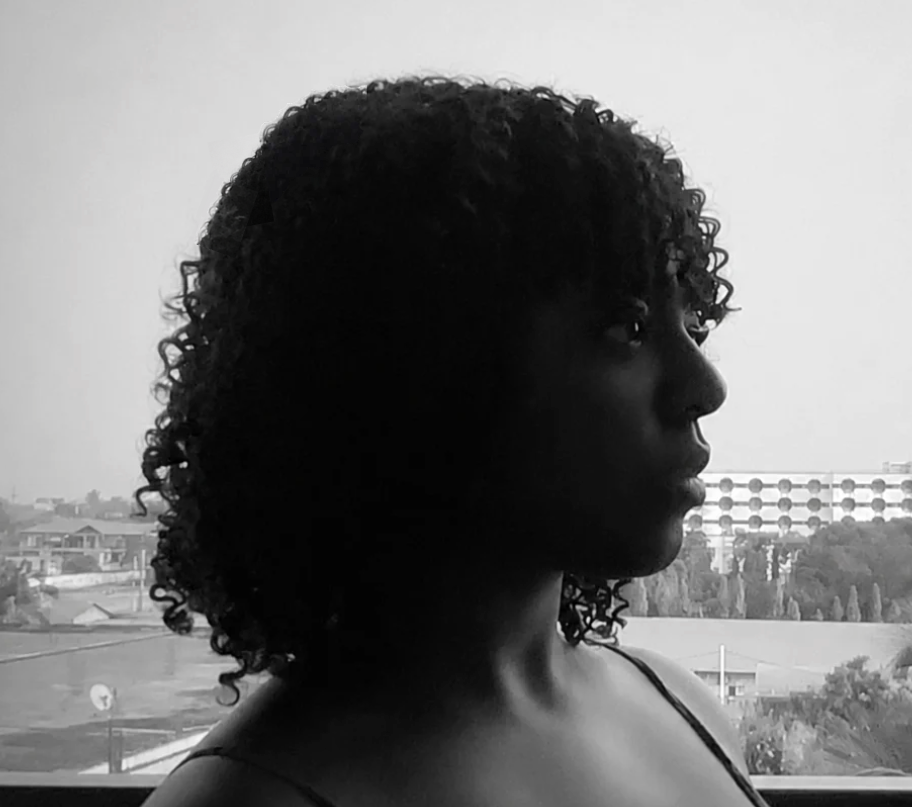
Mia Maisha is a writer from the Democratic Republic of Congo whose work centers around Congolese colonial histories. In her work, she interrogates the brutality of invasion, exploitation, and colonial violence through the lens of ancestral grief, testimony, and collective memory. Visit her blog http://miamaisha.blogspot.com