The old man was singing again. Sister was cursing him. What a delinquent. Raising your voice every night as if the structures surrounding you are inhabited by grasses. Ọ naanị ná Nigeria ka ihe a g’emeli. It is only in Nigeria that things like this can happen. If this had happened in America, would I not have sued you for disturbing the peace? Today, he has added clapping to it. Maybe he is in a good mood. Maybe the Lord has answered his prayer. Mama, on the other end, has been hissing. I fear her lips will tear apart.
The man must have come recently to work on his part in the renovation. Ever since the start of this year, the building beside ours has been undergoing renovation; it was just two weeks ago that his singing began. The first day he started singing, we had thought he was one of those prayer warriors whose prayers would never cross over the third heaven if the neighbourhood did not hear their prayer points; even the ones where they told God to burn every voodoo orchestrating devil incarnate projecting evil against their lives, be it their own mother. We thought he was one of them and did not mind at all. Notwithstanding that it was 10 PM by the time we normally went to bed. Also, notwithstanding, it was not yet midnight when their prayers were most effective to destroy their enemies, who normally would be at work by then. We had thought so until when he sang again the next night, the night after, fifteen nights counting now. If words could emit bullets, a thousand and one shells would be found in the room where the man did his singing, and Sister would surely be found guilty of horrendous murder.
This night, neither his echoing voice, nor Sister’s brutal curses colliding with his choruses, nor Mama’s hissing tongue was in my interest. The bhang smokers in Mama Ikenna’s shop across our house were gyrating. From the bassist symphony in their voices, it seemed like they were too many, much more than what their actual number was always like during the day. Were they having their Bhang Smokers night?
“Amara Chukwu bara uba n’ebe nno”, they sang, accompanying their songs with the rhythmic sound that came from their clicking of a bottle opener against their bottles of beer. Suddenly, Udenwa crossed my mind. That boy. He was one to speak when his name was Udenwa. Who still bore the name Udenwa in this day and age? He had called me an ajebutter. He said I spoke English like one of those brats who went to private schools all their lives, and would never know, would never experience the ecstasy, and the unlimited freedom that was in a government school. He had said ‘brat,’ ‘would never know,’ ‘would never experience,’ with a condescending tone in his voice and a mockish grin on his lips that caused the blood in my face to contract. He said I was not a true African girl. I was one of those wannabe ndiocha whose parents have so continuously shoved the second-hand western education and lifestyle Aba people lived down my throat, that I could no longer tell which was food from toxin entering my throat. The day he snatched my phone with my earphone plugged into it and saw that I had been listening to Phyno’s Obiagu, he cracked stupid jokes, saying I was trying very hard to prove what I was not. The other girls and boys we attended computer class with laughed recklessly, revealing yellow-stained teeth. As if all he had said was not enough, he went further to berate me to the weakest of weaks, that I wouldn’t survive places like Ngwa road if I were left to wander. In defence, I told him I lived on Edinburgh Street.
“Ha! Edinburgh Street? Na Aba nke a anyị nọ n’ime ya? Asi! In the same Aba we’re living in? Lies!”
Udenwa did not know Edinburgh Street. He did not even believe there was a street called Edinburgh in Aba. For all he knew, Edinburgh was the capital city of Scotland and very superior to Aba by way of comparison. That I was so pretentious when I was not wise enough to make my lies seem very plausible, even to the least enlightened person. Then I invited him over. “Come and see with your eyes, will you?” He agreed, eagerly.
One of the bhang smokers would help me. I knew the right one. He had urged me on once, to exchange salutations with him, that my face made him happy. The following morning, I wore my best pendant necklace and earrings. It was real gold. Mama had bought me a set of it – necklace, earrings, and bracelet – when I turned fifteen. The earrings and necklace would do. In class, when we were on recess from the computers, I asked him if he was still going home with me to see the medieval city of Scotland live in Aba, Udenwa affirmed that his mind was still unfazed. At the close of class, we boarded a tricycle that took us from Faulks Road, where our Computer School was located, to Osusu, where we would begin the tour on foot. We walked through a street before we got to the mouth of Edinburgh.
“This is Edinburgh street,” I said, stretching out my right hand in the direction of our destination. Every now and again, as we proceeded, I stole glances at his face, making sure I caught every glimpse of expression on his face, making sure I interpreted every one of those expressions.
His eyeballs moved the most than his head did. They looked at the fences on the ground. And when they looked on the ground, his legs would correspond immediately and jump over something.
I knew he expected to see tall buildings of red brick walls, duplexes with corrugated iron roofs, glimmering black coal-tarred road, but I could see reality tearing down and crushing the foundation that fantasy had built in his mind. Roadside dried swamps with bushes growing atop, a dead rat crushed by a vehicle, and old buildings with algae on the walls were what his eyes could feed on. He was yet to see.
We got to the gate of our yard. He stood behind me, waiting while I reached for the key to the gate at the bottom of my bag. Across the street in Mama Ikenna’s shop, our bhang brothers were there. He was there too, and it was certain he had seen us. We had ignored them. Udenwa ignored them. I suppose stunningness from all he had just seen had held his tongue then. I was still struggling to get hold of the key when I perceived the strong stench of burning grass very close to us. I lifted my head and turned to see the great sight behind me.
“Abobi surrender.” He said, blowing smoke into Udenwa’s face. One of the Bhang brothers was visiting us. His face was rough. There was a scar on his left chin. He had a very obvious nose, and whiteheads were swept all over it.
Udenwa wasted no time in surrendering his phone, the wristwatch he was wearing, and even his transport fare back home. I too joined in the surrendering, and took off my earrings, the necklace, and my phone. All, we surrendered to Caesar.
When we were inside the house in our sitting room, Udenwa didn’t speak or could not speak. I began to apologise for the trouble he had just experienced. I told him, “Udenwa, I’m so sorry for what happened here. This has never happened before. I can’t even imagine what is going through your mind. I led you to trouble.” But Udenwa said it was fine. “Things of that nature are always bound to happen in places like this where people of ‘their’ kind hung around filling their stomachs with smoke,” he said. He stayed for an hour before I saw him off back to the place the tricycle had dropped us, and watched him begin to trek home.
When I was coming back to the house, the bhang smoker with the obvious nose was already at the gate. He brought out the phones and the jewellery without the money and stretched them towards me. I had the premonition that the money wouldn’t be there anyway.
“Oh no, you can keep the jewellery and his phone. I have no need for them.” I said, collecting my phone from him and heading inside.
That night, as I lay in bed while the man sang, and Sister cursed her heart out while Mama hissed her lips to torture, I paid no attention to them again. I did not listen to Sister’s curses, nor did I wish for Mama’s lips not to tear apart. I sang along with him. The day was good.
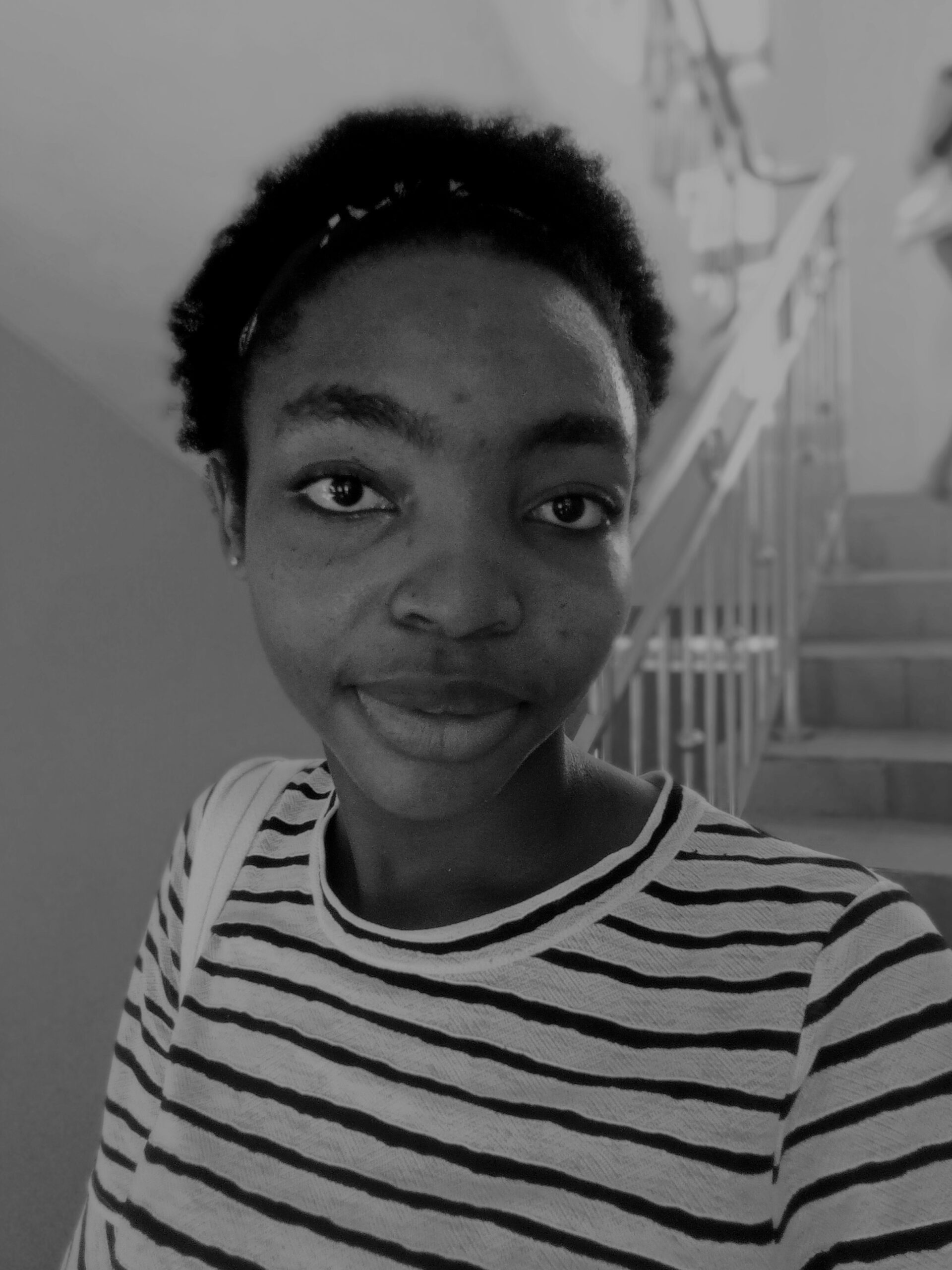
Nneoma Okorie is a Writer and Photographer from Nigeria. She is currently studying English and Literature at the University of Uyo. Her works have appeared on Kalahari Review and Brittle Paper.